17 June 2026 | St Albans, UK [Vanesa Pizzuto]
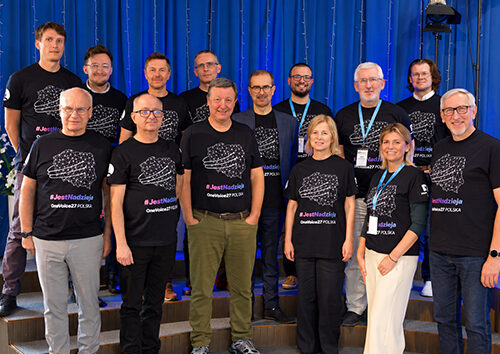
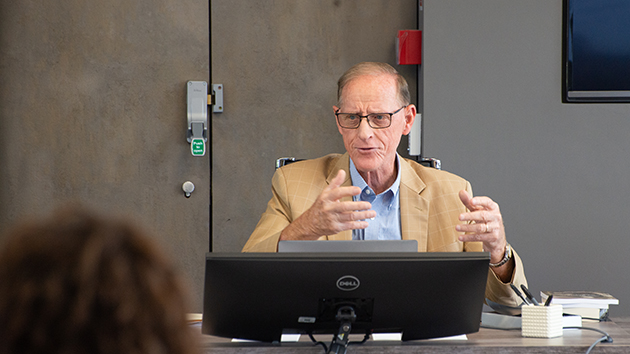
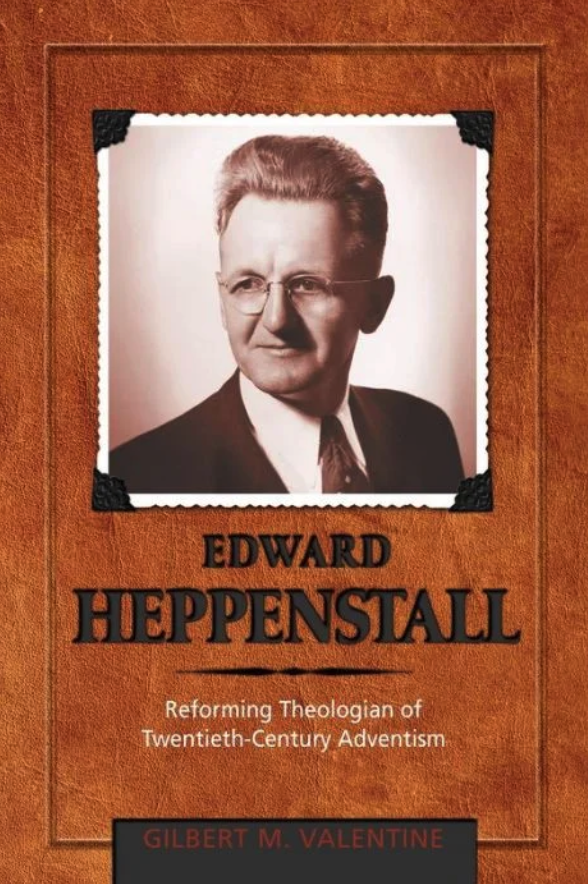
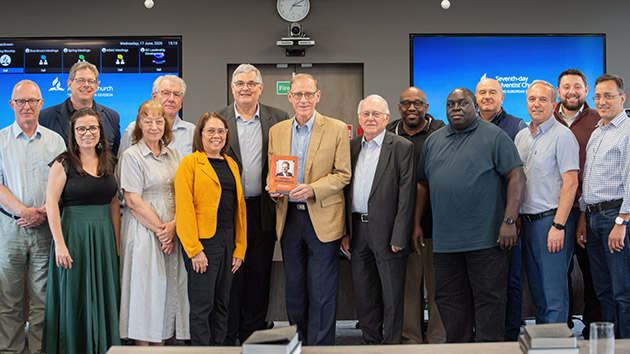
On Wednesday, 17 June, Gilbert M Valentine, PhD, visited the offices of the Trans-European Division (TED) as part of his UK book tour, introducing his latest biographic book, Edward Heppenstall: Reforming Theologian of Twentieth-Century Adventism.
Originally from New Zealand, Valentine has a long-standing connection to the TED, having served for almost six years as a missionary educator in Pakistan, then part of the division’s territory, before later serving at Newbold College of Higher Education (NCHE) as a chaplain, pastor, and lecturer in the Theology Department.
Valentine’s interest in Heppenstall’s life arose while writing a series of articles for the Encyclopaedia of Seventh-day Adventists (ESDA). He realised that sharing Heppenstall’s story (1901–1994) offers a window into twentieth-century Adventism and the challenges it faced.
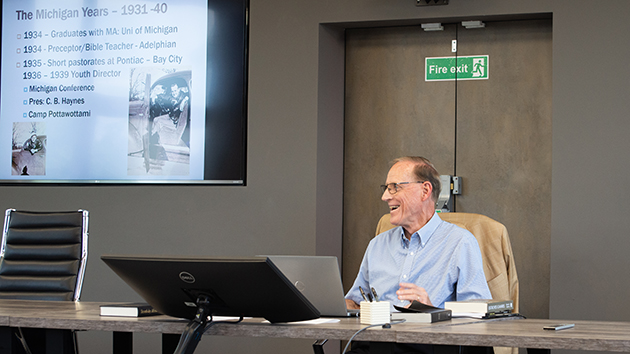
“We can learn much about theology from biography,” said Valentine during his presentation at TED, turning theologian James McClendon’s argument on its head.¹ “This is what I came to appreciate about Heppenstall,” he explained, elaborating on the symbiotic relationship between biography and theology. “It goes both ways. His experience of grace shaped his theology.”
Valentine conducted six years of research in preparation for writing the biography, consulting archives including those at the General Conference, the Clifton Park Museum in Rotherham, and NCHE. When the manuscript was completed, Pacific Press included it as part of the well-known pioneer series because, according to Valentine, “theologically, Heppenstall was a pioneer for the church.”
Indeed, Heppenstall’s influence was considerable. In 1985, he was ranked by North American Division religion teachers as “the most influential thinker and writer among church leaders.” Notably, church pioneer Ellen White was included in the survey, yet Heppenstall emerged as the leading choice.
Through his preaching and teaching, Heppenstall influenced and mentored many church leaders, including Bill Johnson, Sakae Kubo, Morris Venden, and Jan Paulsen. “There was something about his preaching; though you might be in a large congregation, you felt that he was talking to you directly,” Valentine said, describing a common response from those who attended Heppenstall’s lectures and sermons.
“We have much for which to be thankful to Heppenstall,” Valentine shared during his presentation. “He brought to us a non-legalistic way of understanding God,” However, when asked what he appreciates most about Heppenstall, he quickly added, “his commitment to the church and his belief that the church would continue to develop theologically.”
“The church grows and develops over the years; it is not static,” Valentine said. “Heppenstall was a little like WW Prescott in his commitment to the church and its community, helping to hold it together.” When an individual is growing intellectually at a faster pace than the wider community, Valentine suggested that “maintaining personal integrity while not breaking the community” is essential for helping the church move forward.
A Summary of Heppenstall’s Life
Edward Heppenstall grew up in Rotherham, England. When he was just 10 years old, his father died during a hernia operation performed at home on the family’s kitchen table. This tragedy triggered a series of hardships, including the loss of the family’s shop and the separation of its remaining members. To help his mother survive, Heppenstall left school in 1911 and started work at a steel mill shovelling coal. He later developed machining skills in the industry.
In 1915, his mother and sister became Adventists, but Heppenstall did not. These difficult post-war years saw him become involved with local gangs and take up amateur boxing.
After a series of personal losses, a turning point came at work when he witnessed a Baptist colleague respond to humiliation and mockery with remarkable grace. The experience stirred something in him. He began studying the Bible and eventually joined the Adventist Church. The decision came at a cost: he lost his job because of his new faith and his determination to keep the Sabbath.
He later moved to Stanborough Park, Watford, where he studied, assisted with maintenance work thanks to his mechanical skills, and worked as a colporteur during the summers. After five years of study, he graduated as a minister and was then employed at Stanborough as a preceptor and teacher.
After several years in England, Heppenstall moved to Emmanuel Missionary College (EMC) in Michigan, USA. There, he came under the influence of theologian William Prescott, whose Christ-centred approach to theology left a lasting impression on him. In 1934, Heppenstall completed a master’s degree at the University of Michigan.
He later served as a Youth Director in Pontiac, Michigan, where he met Margit Ström, a Norwegian teacher who would become his second wife.
In 1940, Heppenstall was invited to chair the Bible Department at La Sierra College, where he served until 1955. During this period, he took a study leave to pursue a doctorate in religion. Passionate about teaching students to think critically, he championed what he called “the problem method” rather than simple indoctrination. He became known on campus for saying, “It is dangerous to think, but it is more dangerous not to think.”
In 1955, Heppenstall was called to teach systematic theology at the Adventist Theological Seminary in Washington, D.C., where he helped shape a new generation of Adventist theologians. Following the Evangelical-Adventist dialogues of 1955–1956 and the publication of Questions on Doctrine in 1957, Heppenstall was contacted by Walter Martin as he prepared his book The Truth About Seventh-day Adventism. These discussions helped clarify Adventist beliefs and contributed to a broader evangelical understanding of Adventists as Christians rather than as members of a sect.
Heppenstall also played a significant role in reshaping Adventist theology. In the early 1960s, he published a series of articles that reframed the doctrine of the sanctuary, presenting the judgment as being “in favour of the saints” rather than an “investigation of the saints.” In doing so, he challenged long-held assumptions.
Another major contribution came in 1963 when he wrote an article for Signs of the Times challenging the doctrine of Christian sinless perfection. Heppenstall regarded the idea that believers must achieve sinless perfection before the close of probation as non-biblical. Thus, he broke the connection between Adventist soteriology and eschatology. The article sparked a decade-long debate, with books and articles published in defence of both positions.
Following these years of teaching and theological engagement, Heppenstall returned to California, where he served at Loma Linda University. Despite his academic responsibilities, he remained active in evangelism and innovation. In 1967, he led an outreach initiative in London, working alongside seminary students to share the Gospel with the Beatnik community in Trafalgar Square.
Retirement marked the beginning of a new chapter. Heppenstall turned his attention to writing, publishing persuasive books including Our High Priest, Salvation Unlimited, and The Man Who Is God. His voice remained highly influential within the church, and during the theological tensions surrounding Glacier View in 1980, he was invited to serve on the Sanctuary Review Committee.
Heppenstall died on 22 August 1994. Although Alzheimer’s disease eventually robbed him of the ability to remember his own contributions, those who knew him and were shaped by his ministry remember him as the theologian who could confidently say, “Judgment is not a disaster. It is good news for the believer.”
¹ James McClendon (1924–2000) was a Christian theologian. In his book Biography as Theology, a key text of the narrative theology movement, he proposed the use biography as a way of doing theology.
[Photos: Joe Philpott]