4 November 2026 | Gothenburg, Sweden [Tor Tjeransen]
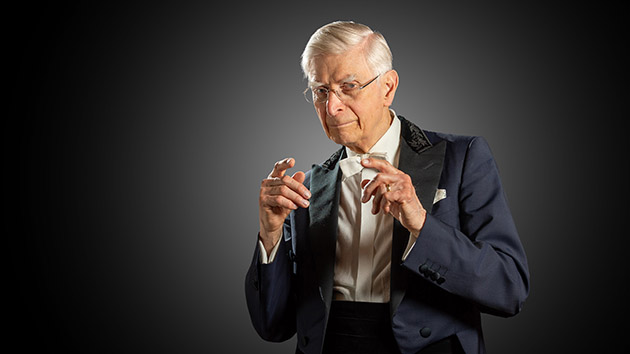
Herbert Blomstedt, one of the world’s best-known Seventh-day Adventist conductors, died on 4 November at his home in Gothenburg, according to a statement from his management.
“Easy things do not interest me. I like difficult things. In that way, I am a hopeless youngster,” the beloved conductor said in an interview at age 93. This attitude continually motivated him to grow as a musician.
Blomstedt was a successful orchestral conductor and a remarkable figure in classical music. Even after turning 90, he remained in demand among the world’s leading orchestras, regularly appearing as a guest conductor. He conducted his last concert at age 98 on 15 May 2026, leading the San Francisco Symphony in Mahler’s Ninth Symphony.
Blomstedt was born on 11 July 1927 in the United States to an Adventist pastor and his wife. When he was two, the family moved back to their native Sweden.
There, he began his musical education at the Royal Conservatory in Stockholm and Uppsala University. He later studied conducting at the Juilliard School of Music in New York, contemporary music in Darmstadt, Germany, and Renaissance and Baroque music at the Schola Cantorum in Basel, Switzerland.
“Music keeps me young”
Blomstedt demonstrated an impressive ability to analyse the works he conducted in fresh, new ways. He never assumed he knew a work so well that he no longer needed to prepare thoroughly. He always approached a score as if he were seeing it for the first time, carefully analysing it to discover the inner logic of the composer’s intentions. “If you think you’re good and don’t need to prepare, think you may take it easy, that is the beginning of the end,” he said in a 2014 interview.
“Music keeps me young. I have great curiosity, and in that way, I am still like a child. I have learnt a little bit over the years, but most of all I’ve learnt that I know far too little,” Blomstedt told Mark Pullinger in an interview in December 2020, while preparing for concerts with the Bavarian Radio Symphony Orchestra.
Musicians on three continents came to love Blomstedt and made a point of attending his rehearsals. “None of our musicians would be on sick leave when Blomstedt was in town,” a member of the Oslo Philharmonic confided.
Rehearsing under Blomstedt’s guidance was like attending a seminar. He was passionate about music, and simply listening to an orchestra’s sound brought him great joy. It was his job to make that sound as close to the composer’s intentions as possible. He paid attention to every detail and often hummed a few bars to show how he wanted the music to sound.
Blomstedt regarded orchestra members as specialists working towards a common goal. He was always looking for ways to improve his performance. The harder the task, the better. “Easy things do not interest me. I like difficult things,” he said in an interview with Deutsche Welle.
His quest for perfection was always accompanied by the joy he found in performing with an orchestra. This was evident to the musicians, who could see the almost childlike delight music brought him as he conducted. After concerts, Blomstedt would not go straight to his dressing room, but would stand at the stage exit to thank the musicians personally.
Blomstedt was considered an authority on the music of the Austrian composer Anton Bruckner. In 2023, Accentus Music released a collection of CDs featuring all nine of Bruckner’s symphonies, recorded live with Blomstedt conducting the Gewandhausorchester Leipzig. The publisher wrote about the recordings: “Bruckner’s symphonies are strenuous alpine hikes, and Blomstedt is a mountain guide who not only has the next fork in the road in mind but knows every stone on the path before the group has even started.”
After Blomstedt performed Bruckner’s Ninth Symphony with the Berliner Philharmoniker in December 2024, at 97, Monika Rittershaus wrote: “It is difficult to put the incredible energy of this artist into words.”
Blomstedt saw his extraordinary vitality in old age as a gift from God. “The gift of good health must never make us arrogant,” he maintained.
His father taught him to focus on what had “eternal value”. In classical music, the conductor felt that he could offer the public something of eternal value.
Man of faith
Herbert Blomstedt was a committed Seventh-day Adventist. Throughout his career, he never scheduled rehearsals on Friday evenings or Saturdays to observe the biblical Sabbath. He would, however, conduct concerts, regarding this as an expression of his religion and a form of worship. “I am convinced that the music we play at a concert may open the way to an encounter with God for those who are sensitive to classical music,” he once said.
His Christian convictions remained central to his life and career. Orchestra managers around the globe knew he was a Seventh-day Adventist and respected him for remaining faithful to his beliefs. The New York Philharmonic wrote: “His work as a conductor is inseparably linked to his religious and human ethos.”
Blomstedt believed that being a public figure known for his faith carried a particular responsibility. That combination required humility. He would cite Albert Schweitzer: “Example is not the main thing in influencing others. It is the only thing.” Blomstedt wanted to be known not for his words, but for the life he lived. That life earned him the respect and affection of musicians and audiences worldwide.
Photo: Tor Tjeransen / AME (CC BY 4.0).